Highlights
origin of orbital order: solution of chicken and egg problem
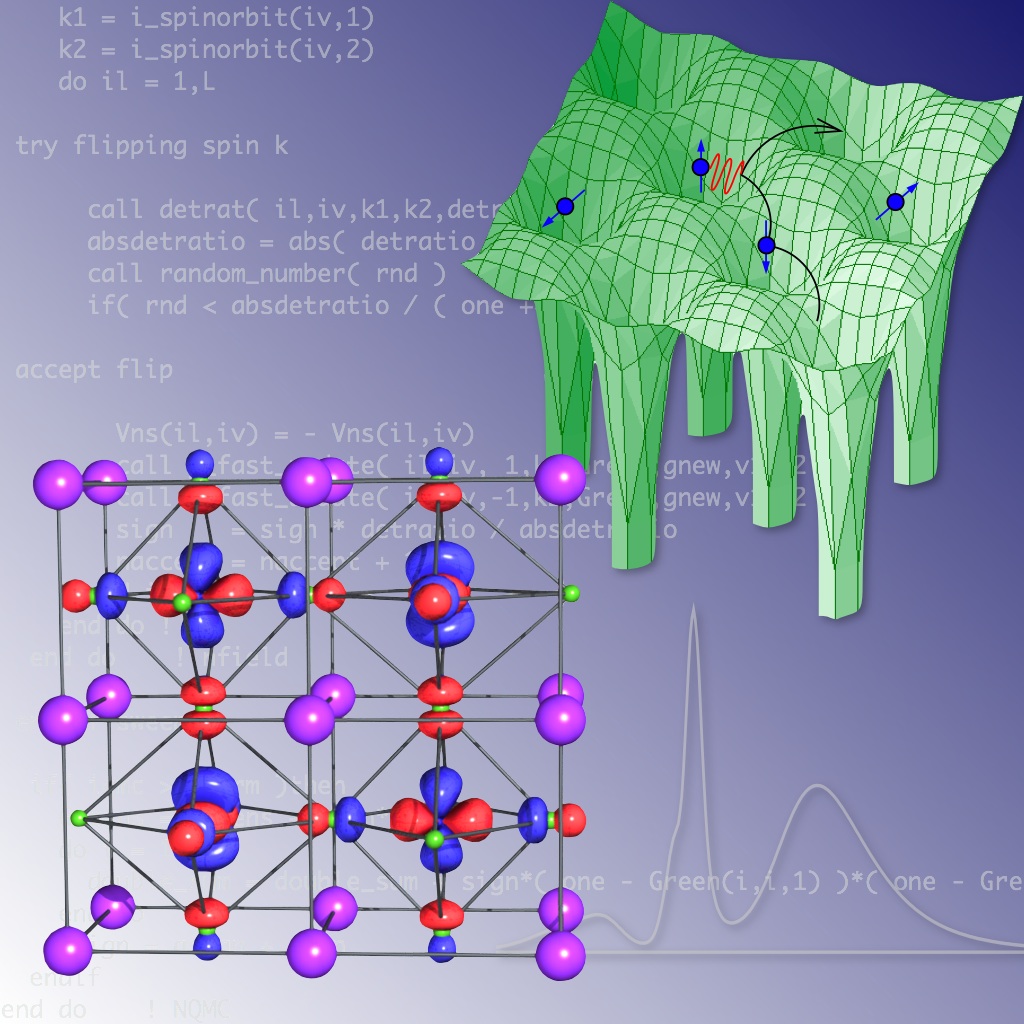
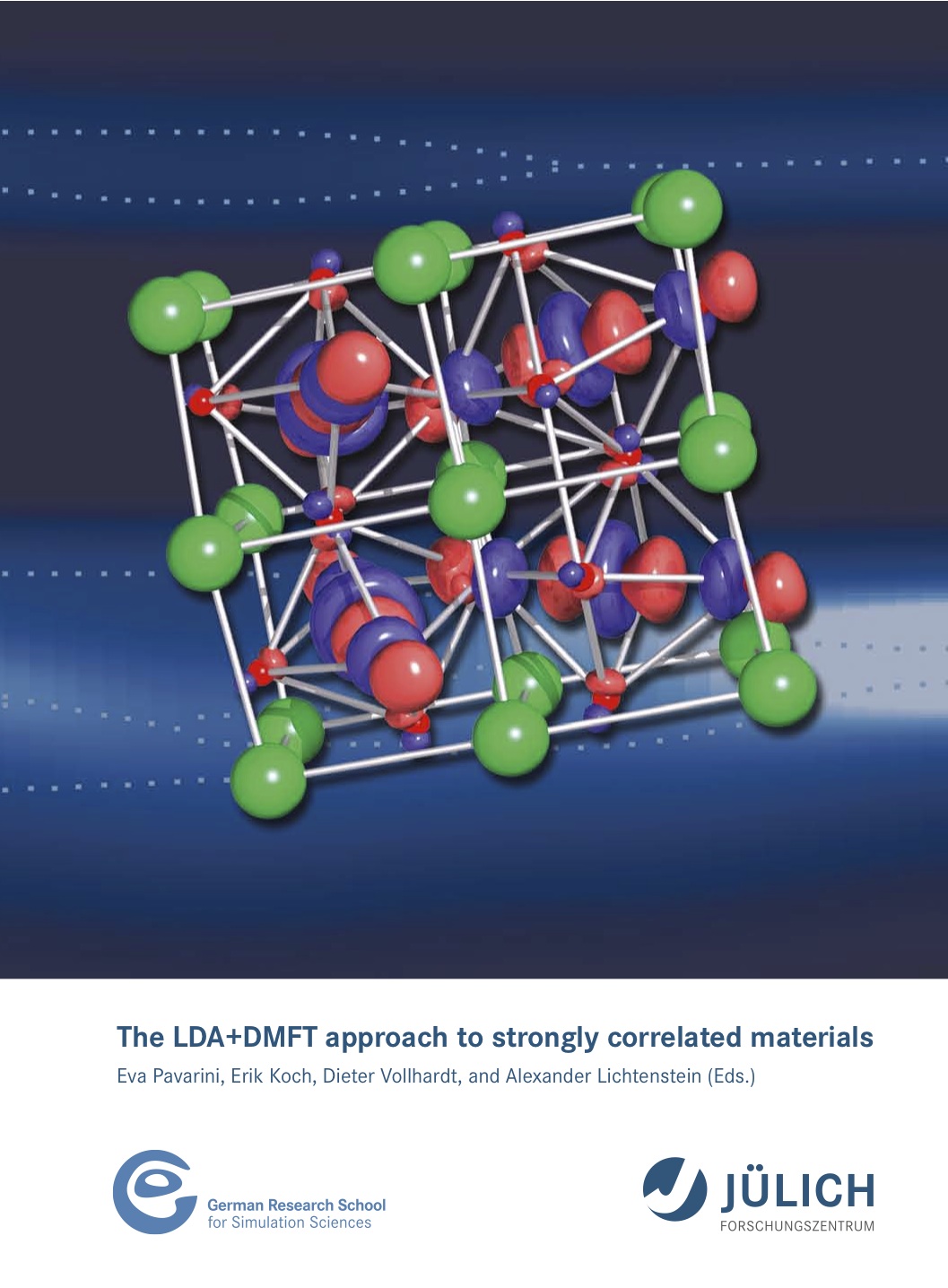
The origin of orbital order has been debated for decades. Two mechanism have been proposed, the purely electronic super-exchange interaction of Kugel and Khomskii and the classical (perhaps Coulomb enhanced) Jahn-Teller coupling. We have solved this problem by developing a new approach which we combined with LDA+DMFT. In a series of papers we have shown that, in the text-book examples of orbitally ordered materials, KCuF3 and LaMnO3, (i) the Kugel-Khomskii mechanism yields large orbital-ordering temperature but (ii) unfortunately too low to explain the existence of orbital order in real materials at very high temperature. To explain the latter, a static crystal-field, as the one due to the Jahn-Teller effect, is necessary. Finally, we have shown that not even the Jahn-Teller interaction can give the observed order alone. A key role is played by the Born-Mayer repulsion potential.
Main papers:
Recently we have introduced a new powerful and flexible method for constructing general material specific super-exchange Hamiltonians and we identified the first clear case of a Kugel-Khomskii material:
For a pedagogical introduction to orbital ordering you might see the lecture notes:
Mott transition, spin-orbit effects, magnetism and Fermi surface of correlated ruthenates, rhodates and iridates
We have explained the nature of the metal-insulator transition in Ca2-xSrxRuO4.
We have shown that the L-Pbca --> S-Pbca structural change plays a key role.
We have shown that, contrarily to what has been suggested, the spin-orbit interaction is not crucial.
We have shown that Coulomb-enhanced spin-orbit and low-symmetry Coulomb terms are instead both
essential to explain the Fermi surface of Sr2RuO4.
Our studies are the first LDA+DMFT calculations including at the same time the actual crystal structure, the crystal-field splitting and the spin-orbit interaction and the full Coulomb vertex .
We have shown the the Fermi surface of Sr2RuO4 can only be explained when both the Coulomb-induced spin-orbit enhancement (about a factor of two)
and the tetragonal Coulomb terms (which reduce the Coulomb-induced crystal-field enhancement to almost zero) are included.
Main papers:
Phys. Rev. Lett. 104, 226401 (2010)
More recently we worked on understanding rhodates and iridates. See publication list.
generalized CT-HYB and CT-INT QMC solvers for DMFT
We have developed generalized CT-INT (continuous-time interaction-expansion) and CT-HYB (continuous-time hybridization-expansion) DMFT quantum Montecarlo solvers.
These allow us to study Hamiltonians
and Coulomb matrices of any symmetry, with and without spin-orbit interaction.
We have found that the sign problem can be minimized by optimal basis choices, e.g.,
rotating to a crystal-field basis, which diagonalizes the one-electron part of the on-site Hamiltonian [Flesch et al, 2013].
This idea has been later exploited also by other groups to reduce the sign problem in the presence of spin orbit coupling.
We have found a scheme for accounting for the double-counting correction in the presence of low-symmetry Coulomb terms.
Main papers:
Phys. Rev. Lett. 104, 226401 (2010)
building many-body models for molecular systems
We have developed a general and efficient method to construct ab-initio many-body models for strongly-correlated molecular nano-magnets.
Main theory papers:
Phys. Rev. Lett. 110, 157204 (2013)
Phys. Rev. B 94, 224422 (2016)
Phys. Rev. B 99, 235145 (2019)
For applications see publication list.
the spin-state transitions in cobaltates
We have explained the spin-state transitions in cobaltates as the result of a delicate balance
between super-exhange energy, multiplets and crystal-field. We have mapped this competition
into a Ising-like model with parameters calculated ab-initio. We have shown that commonly used approximations
to the Coulomb tensor might lead to completely incorrect results.
Main papers: